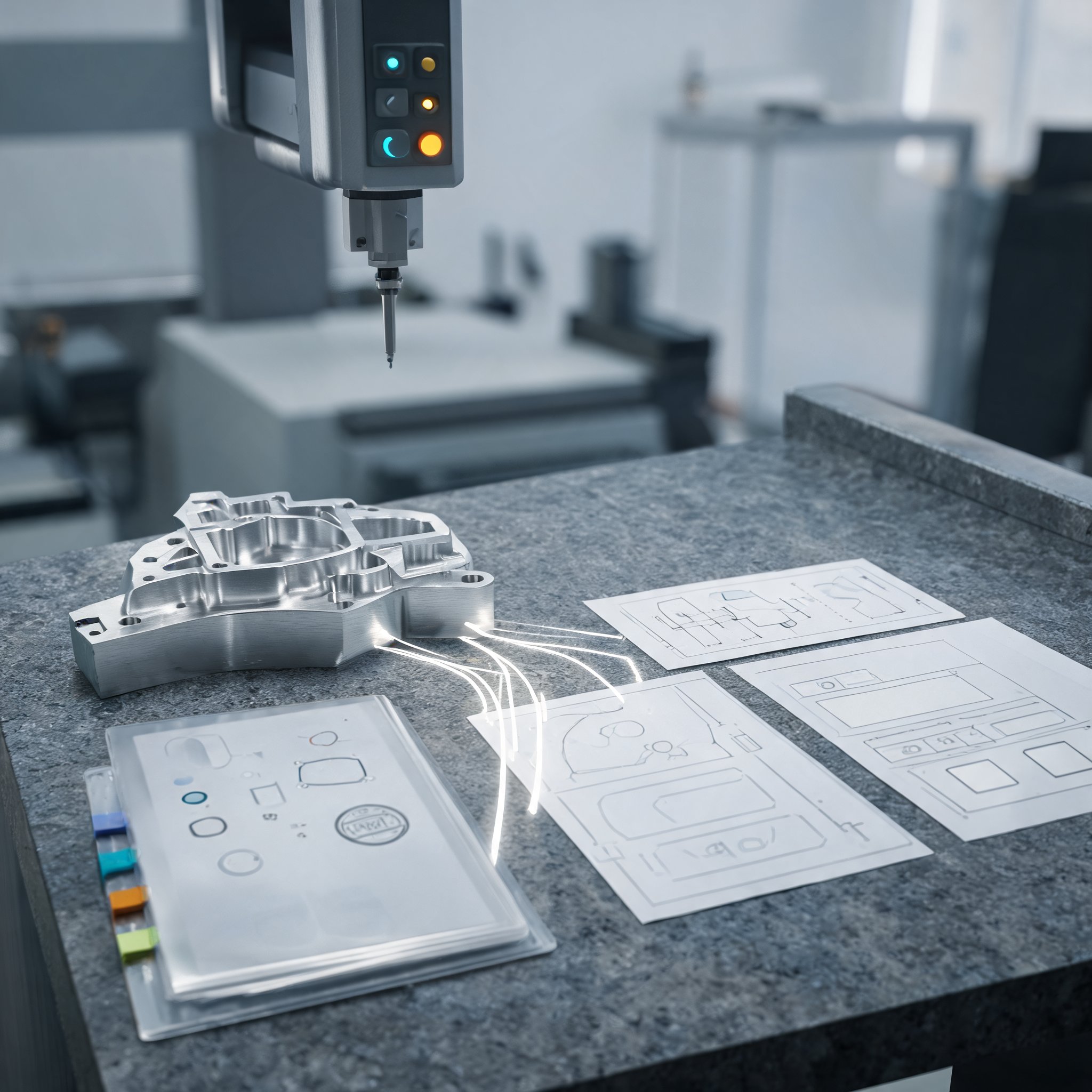
AI-assisted inspection can produce a precise number and still support the wrong decision. If a part is checked against an obsolete drawing revision, the instrument can measure faithfully, the software can generate a polished report, and the team can reach the wrong conclusion faster. Gleb Tsipursky, a behavioral scientist, argues that this failure mode becomes more important as metrology systems become more connected.
The technical promise is traceability. Persistent-identification work using the Quality Information Framework (QIF) can preserve the identity of a measured characteristic across product definitions, inspection plans and results. That capability is necessary but not sufficient. The management challenge is ensuring that each decision follows the correct version of the requirement. A result can be arithmetically correct while its conclusion is invalid because the specification behind it is out of date.
From traceability to version context
Tsipursky proposes that every consequential measurement carry a 'version passport.' The idea does not require a new software platform. It can begin as a set of fields that travel with a result:
- the approved drawing or model revision;
- the characteristic identifier;
- the inspection-plan revision;
- the instrument or method used;
- the result timestamp; and
- the identity of the person or system that approved the disposition.
Together these fields make the origin and applicable conditions of a measurement visible to the next decision-maker. They turn traceability from a back-office record into context that can be checked at the point of decision.
This matters because AI can already summarize an inspection report, point to an apparent deviation or recommend which cases need review. But a tool that receives results without version context may compare an observation with the wrong specification. The model's arithmetic can be correct while its conclusion is invalid. Human reviewers face the same risk when records are incomplete. The National Institute of Standards and Technology's 2026 smart-manufacturing roadmap identifies integration of heterogeneous data and trustworthy operation as continuing challenges for industrial AI; a version passport addresses a specific part of that problem.
The passport does not remove the need to validate the measurement itself. It adds a second check: whether the requirement used for the decision was the approved one at the time. That check becomes more important when records move between systems and teams.
Test the record, not just the label
Quality teams can test the concept before integrating a new platform. The proposed method is to select a small set of completed inspection records that includes one legitimate out-of-tolerance result, one conforming part and one example with mismatched revisions. An AI assistant is then asked to summarize the evidence. The test requires it to identify the applicable revision and flag missing provenance, and compares its responses with an experienced quality engineer's determination.
The evaluation should not stop at how often the assistant labels a part good or bad. More revealing questions are whether it catches a revision mismatch, whether it invents an unstated tolerance and whether it can point to the approved source behind a conclusion. Those are the errors that digital handoffs often conceal. A confident summary can travel further than the evidence behind it, especially when records are combined across systems and teams.
A version passport also changes what gets handed off. Instead of passing along a number and a report, the quality team passes along the conditions under which the number should be read. That does not guarantee a correct decision, but it gives the next reviewer a way to detect when the measurement and the requirement no longer belong together. It also makes missing information visible rather than silently filling the gap with an assumption.
Ownership before the alert
Records will sometimes disagree, and the escalation route must be settled before an alert appears rather than negotiated during a shipment dispute. The proposal assigns different responsibilities: a quality engineer may determine whether a measurement is valid; design engineering confirms the governing definition; manufacturing determines whether production can continue. Clear ownership keeps a version mismatch from becoming a procedural argument after the fact.
The argument differs from the familiar demand for more AI-versus-human comparisons. Even perfect agreement between human and automated inspectors can reinforce the wrong decision if both were given an obsolete specification. The reference itself needs scrutiny. Automation can make measurement data travel farther and faster, but a reliable chain of custody ensures that the drawing, feature, method and result still belong together when the decision is made.
The version passport is therefore less a technical novelty than an information discipline. It does not by itself prove that an inspection is correct, and it does not replace engineering judgment. It does make the conditions of a decision inspectable. For manufacturers adopting AI-assisted inspection, that is a practical first step: attach the right context to each consequential measurement, test whether AI systems can recognize when that context is missing or mismatched, and decide in advance who resolves the conflict. The next generation of connected inspection should make that connection impossible to ignore.