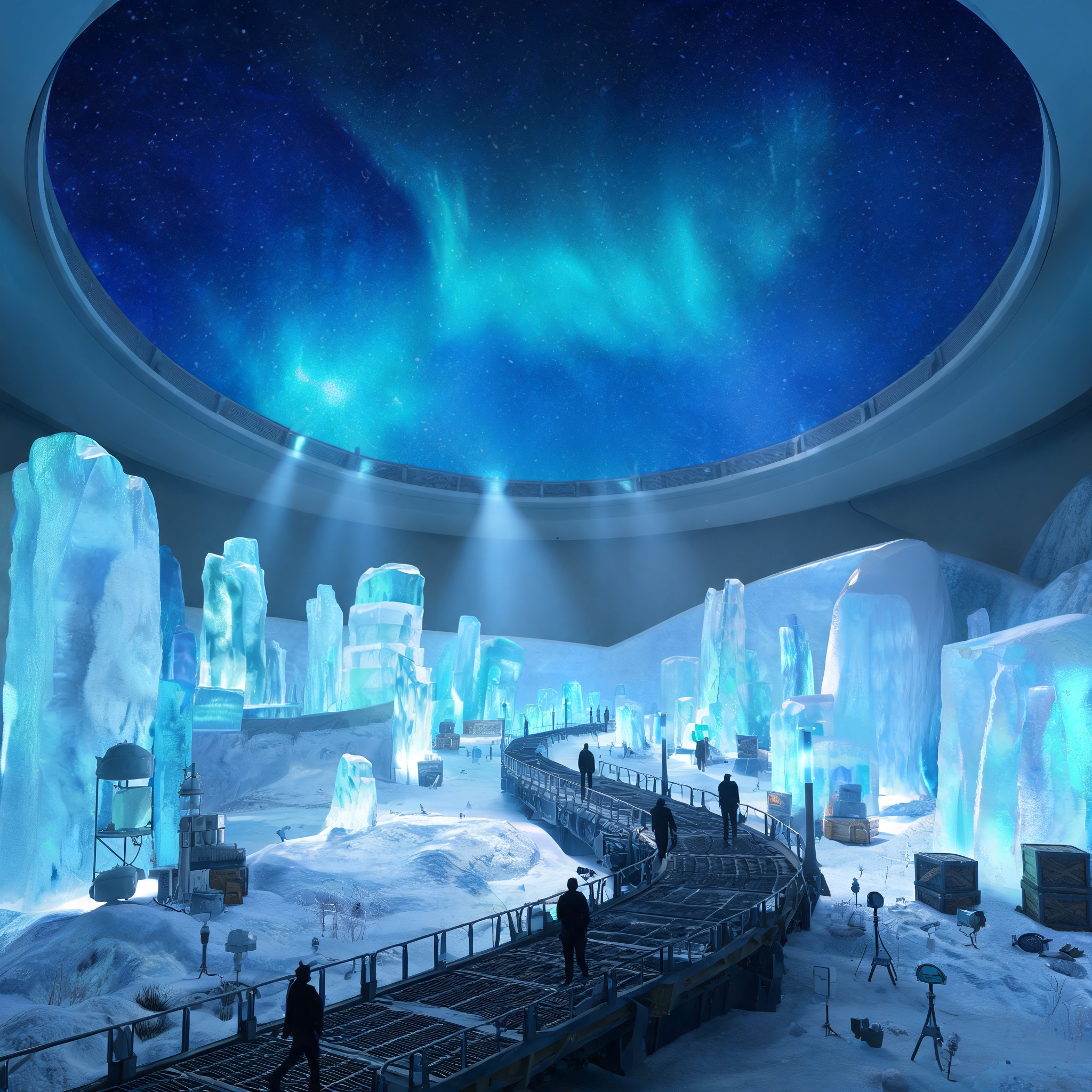
POLAR EXPERIENCE, an immersive exhibition devoted to the Arctic and Antarctic, welcomed more than 120,000 visitors during its four-month world premiere in Berlin, according to the project. The show combines scientific research, cinematic storytelling and multisensory design. It is presented by Galileo and Galileo Kids, conceived by Nicole Srock.Stanley and developed by dan pearlman.
Rather than relying on facts and statistics alone, the exhibition casts visitors as members of a modern polar expedition. The journey begins with boarding the legendary research vessel Polarstern and continues through frozen landscapes, ice formations, polar wildlife, Indigenous communities and scientific missions that have shaped understanding of climate change. It ends in a 360-degree projection environment combining large-scale visuals, surround sound and choreographed storytelling.
Science at the foundation
The project was developed with scientific institutions including the Alfred Wegener Institute and polar researcher Prof. Dr. Markus Rex. Scientific accuracy is described as the foundation of the visitor journey, with each story, environment and installation designed to communicate complex research in an accessible way. The exhibition positions immersive media as an educational platform rather than spectacle alone, and its innovation is framed as extending beyond technology to the link between science, entertainment and social impact.
Its tone is intended to be empowering rather than fear-based. A final “Act Now” area presents practical opportunities for climate engagement, partnerships and personal contribution, aiming to leave visitors with a sense of responsibility and agency as well as new knowledge.
Accessibility and collaboration
Accessibility is built into the format. A multilingual audio guide accompanies the full journey, while younger visitors are guided by Cosmo, a character from Galileo Kids, to make scientific topics engaging for children. The layered storytelling is designed to let families, school groups and adults with different levels of prior knowledge engage at their own level.
The exhibition also involved scientists, filmmakers, Indigenous representatives, educators, media partners, creative designers and immersive technology specialists. According to the project, scientific expertise shaped the exhibition from its earliest stages rather than being added after the creative concept was complete. That interdisciplinary process was intended to produce an experience that is both emotionally compelling and scientifically trustworthy.
Partners and public response
The Alfred Wegener Institute, Helmholtz Centre for Polar and Marine Research, is the scientific partner. WWF Germany contributes expertise to the exhibition content. FKP Scorpio Entertainment is local promoter in Oberhausen, Cofo Entertainment was local promoter in Berlin, Seven.One Starwatch acts as media partner and GLS Bank supports the project as sponsor.
The Berlin run’s visitor figure and the reported audience and media acclaim are presented as confirmation of the approach. The project team says the exhibition sets a new benchmark for immersive exhibitions by connecting audiences emotionally with global challenges while maintaining scientific credibility; it describes innovation not as technical sophistication alone but as the ability to create that connection.