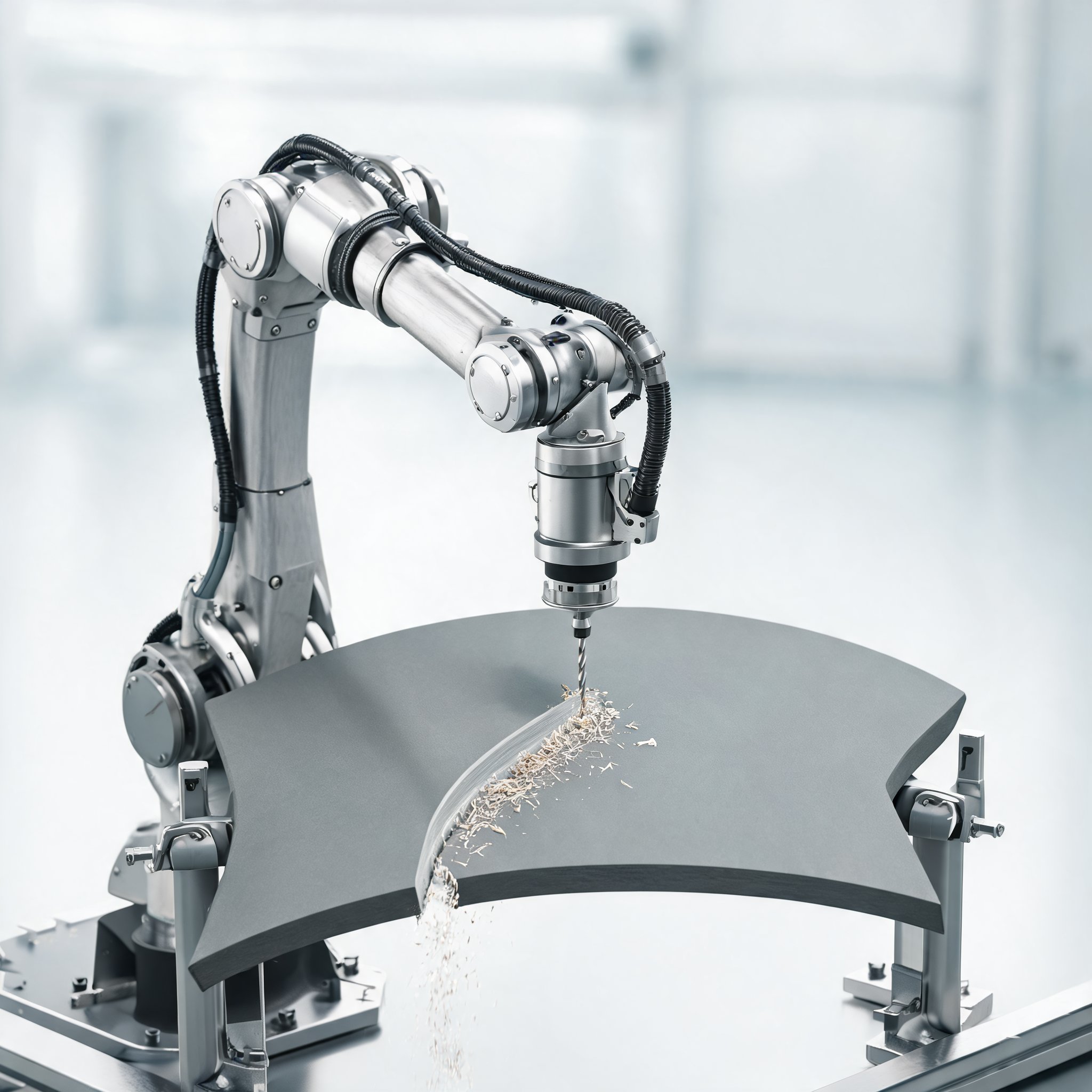
Fives High Precision Machines (Fives HPM) is positioning its Liné Machines RoboTDM as an alternative to large CNC machine tools for components that need consistent accuracy but not the tightest tolerances. The system mounts a spindle, toolholder and cutter on an industrial robot arm and takes the cutting tool to the workpiece instead of moving a large part into a machine envelope.
Where robotic machining fits
According to Fives, the concept suits work where tolerances of roughly 0.1 mm are acceptable. In those cases, the company argues, buying a large CNC machine can mean paying for capability the job does not use, along with substantial set-up and programming time. RoboTDM is intended to shorten set-up, simplify programming and avoid the cost and floor space of a large machine.
- Face milling and deburring, including burr removal from castings and trimming of excess weld beads
- Pilot-hole drilling on large aerospace panels and automotive body parts
- Trimming, routing, drilling, edge contouring and pocketing on large composite or thermoplastic fabrications
Narrowing the accuracy gap
Industrial robots have generally traded positional accuracy for flexibility, with conventional systems reaching tolerances of about 0.3 mm, which Fives describes as too loose for many machining tasks. The company says its development work focused on that gap. Robot calibration combined with look-ahead and motion-planning algorithms allows programs containing more than one million points to run without the latency that can distort robot motion, producing smoother trajectories for multi-axis contouring.
Fives states that RoboTDM can hold machining deviation to about 100 μm (0.1 mm), a threefold improvement on conventional robotic accuracy. Research and development trials spanning several years reported cycle time reductions of up to 70% in trimming and milling, with some individual applications achieving greater savings.
Configuration and process options
The machining end effector can be specified with different spindle sizes, power ratings, torque and speed. Fives lists spindle power up to 125 kW, torque up to 80 Nm and speeds reaching 30,000 rpm, with HSK A63, HSK F63 or HSK A100 taper toolholders. Automatic tool changing, tool measurement, tool-breakage detection and part probing can be added, and a vision system can support drilling work. The platform is also configurable for waterjet cutting, laser profiling and ultrasonic cutting.
Installation, target sectors and limits
Multiple workstations and customised peripheral equipment are possible, and foundation requirements are described as modest compared with a large CNC machine tool, which helps when parts are too big or awkward to move through a conventional machine. Fives points to aerospace, defense, maritime and energy as likely fields of use, where component dimensions can be substantial and production requirements vary considerably.
The company does not claim the approach covers every case: where tolerances tighter than 0.1 mm are required, a high-precision CNC machine remains the appropriate choice, making RoboTDM complementary to the wider Fives HPM portfolio. Fives Liné Machines Inc, based in Granby, Quebec, Canada, has had a North American presence for almost 50 years and produces both Liné CNC machine tools and robotic solutions, including RoboTDM, with on-site engineering, integration, automation, service and training support across equipment lifecycles.