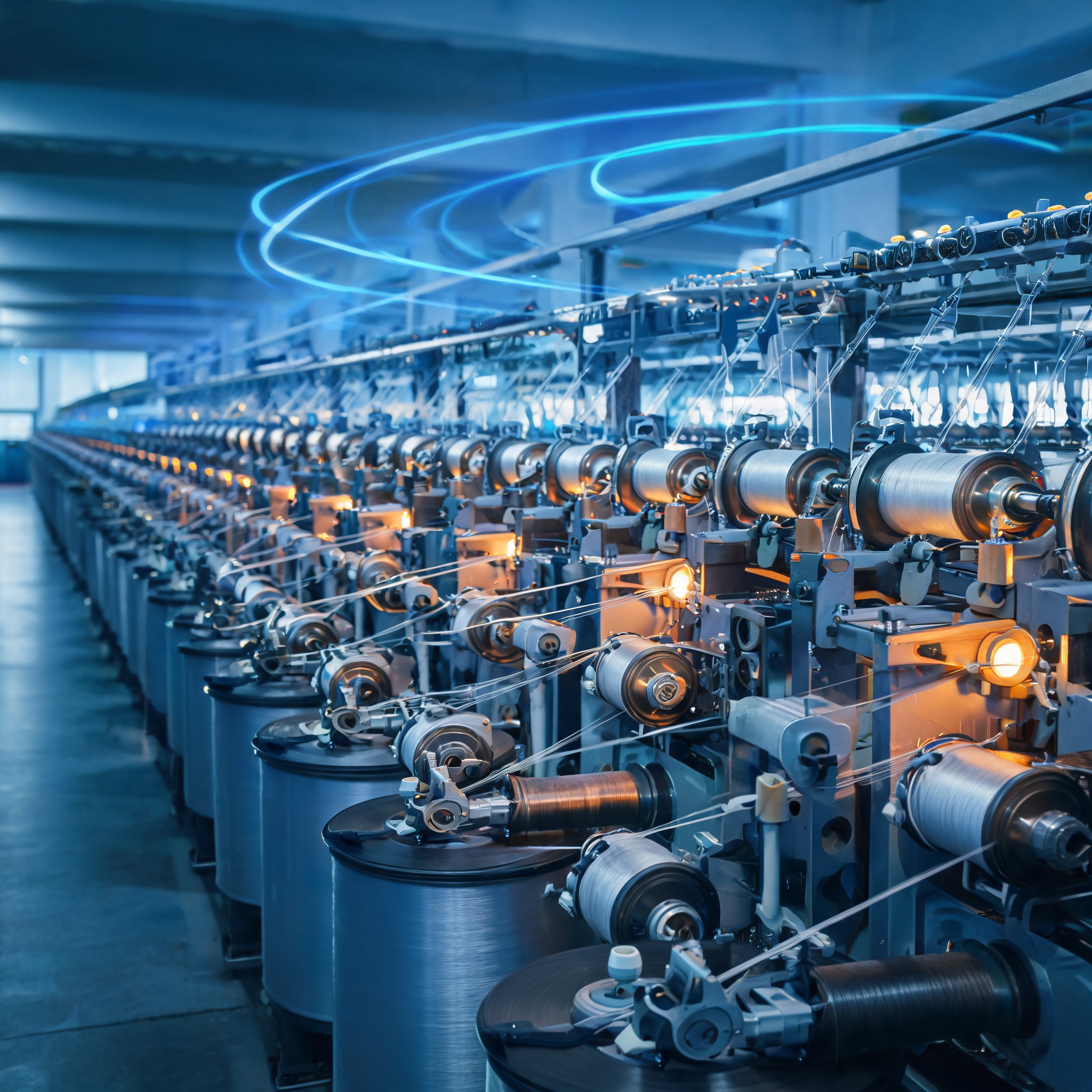
Barmag, a supplier of machinery for man-made fiber production, plans to strengthen its engagement with Bangladesh's textile industry and will present a new generation of spinning, texturing and digital systems at ITMA ASIA + CITME 2026 in Shanghai.
The company's portfolio covers filament spinning systems, texturing machines, BCF and staple fiber systems, nonwoven solutions, polycondensation and extrusion systems and their key components, plus automation, digital tools and high-precision gear metering pumps for textiles and other sectors. In a Textile Focus interview, André Wissenberg, Vice President and Head of Marketing, Corporate Communications and Public Affairs at Barmag GmbH & Co. KG, set out the market conditions behind its plans.
Global machinery market faces cost and labor pressure
Wissenberg said the global textile machinery industry is undergoing a significant transformation, with manufacturers facing pressure from energy costs, sustainability requirements, labor shortages and the need to stay competitive in highly dynamic markets. Demand for high-quality man-made fibers still creates opportunities where performance, consistency and cost efficiency matter, and Barmag sees potential in advanced polyester and polyamide production, recycled materials, technical textiles and increasingly automated manufacturing. Rather than supplying individual machines, the company says it aims to help customers optimize entire production processes by combining machinery, automation, digitalization and process expertise.
Energy efficiency and Bangladesh's supply constraints
Asked how its technology can help mitigate Bangladesh's energy crisis, Wissenberg said reliable, affordable energy is a major concern for the country's textile industry, and that when supplies are uncertain and costs rise, manufacturers need every opportunity to improve efficiency.
He cited the eFK EvoSmart texturing machine, which combines heater technology and intelligent godet control and — depending on configuration and operating conditions — can reduce specific energy consumption by up to 25 percent. The new POY 2.0 spinning concept is also meant to improve resource efficiency; its redesigned spinning beam can cut energy consumption by up to 10 percent, while better process control and yarn quality are intended to reduce waste. The atmos.io platform provides production data and process transparency that the company says helps manufacturers identify inefficiencies.
Wissenberg qualified the claim, however: energy-efficient machinery cannot compensate for an interrupted gas supply or an unreliable electricity grid. What it can do, he said, is help manufacturers use available energy more efficiently, lower energy costs per kilogram of yarn and strengthen competitiveness when production conditions allow. For Bangladesh, he framed such investment as part of a broader strategy to build a more resilient and competitive textile industry.
Innovations planned for ITMA ASIA + CITME 2026
At the Shanghai show, Barmag will present a portfolio spanning filament spinning, texturing, staple fibers, nonwovens and digital production. A key highlight is POY 2.0, which rethinks how spinning, quenching and winding interact. Its centerpiece is the new WINGS POY 2.0 winder, featuring a fully automatic string-up function intended to reduce operator intervention, shorten start-up times and minimize waste; the concept also includes a redesigned spinning beam and the EvoQuench 2.0 system.
Another innovation is eFK EvoSmart, whose optimized process control, EvoHeater technology and Smart Godets are designed to cut energy consumption while supporting consistent yarn quality and lower maintenance. Barmag will also show WINGS FDY FLEX, a flexible winding concept for a broad range of yarn types and rapid product changes, including recycled polyester. Digitalization is represented by atmos.io, a platform for connected, transparent yarn production. Beyond filament production, the Neumag portfolio includes EvoSteam for staple fiber production, FiberGuard BCF for monitoring and process control in BCF yarn production, and hycuTEC for nonwovens.
Barmag said visitors can find these solutions at booth D45 in Hall 6.1 at the National Exhibition and Convention Center in Shanghai from November 20 to 24, 2026.
Bangladesh market and partnership plans
Wissenberg described Bangladesh as an important textile manufacturing country with a strong export-oriented industry and an established position in global supply chains, adding that Barmag sees opportunities for advanced man-made fiber technologies as manufacturers seek better quality, efficiency and competitiveness.
He said the company looks at the entire value chain, from continuous polycondensation, spinning and texturing to final bobbin handling, focusing on producers of polyester and polyamide filament yarns as well as staple fiber and technical textile applications. Given energy uncertainties, cost pressures and investment constraints, he said manufacturers should evaluate new machinery by its long-term economic benefits.
Looking ahead, Barmag wants to strengthen its engagement with the Bangladeshi textile industry through closer customer relationships, technical consultation and cooperation with local partners. Wissenberg said the aim is not simply to sell machinery but to build long-term partnerships that help customers achieve sustainable improvements, adding that Bangladesh has the industrial expertise, entrepreneurial spirit and international market connections to remain an important player in global textiles.