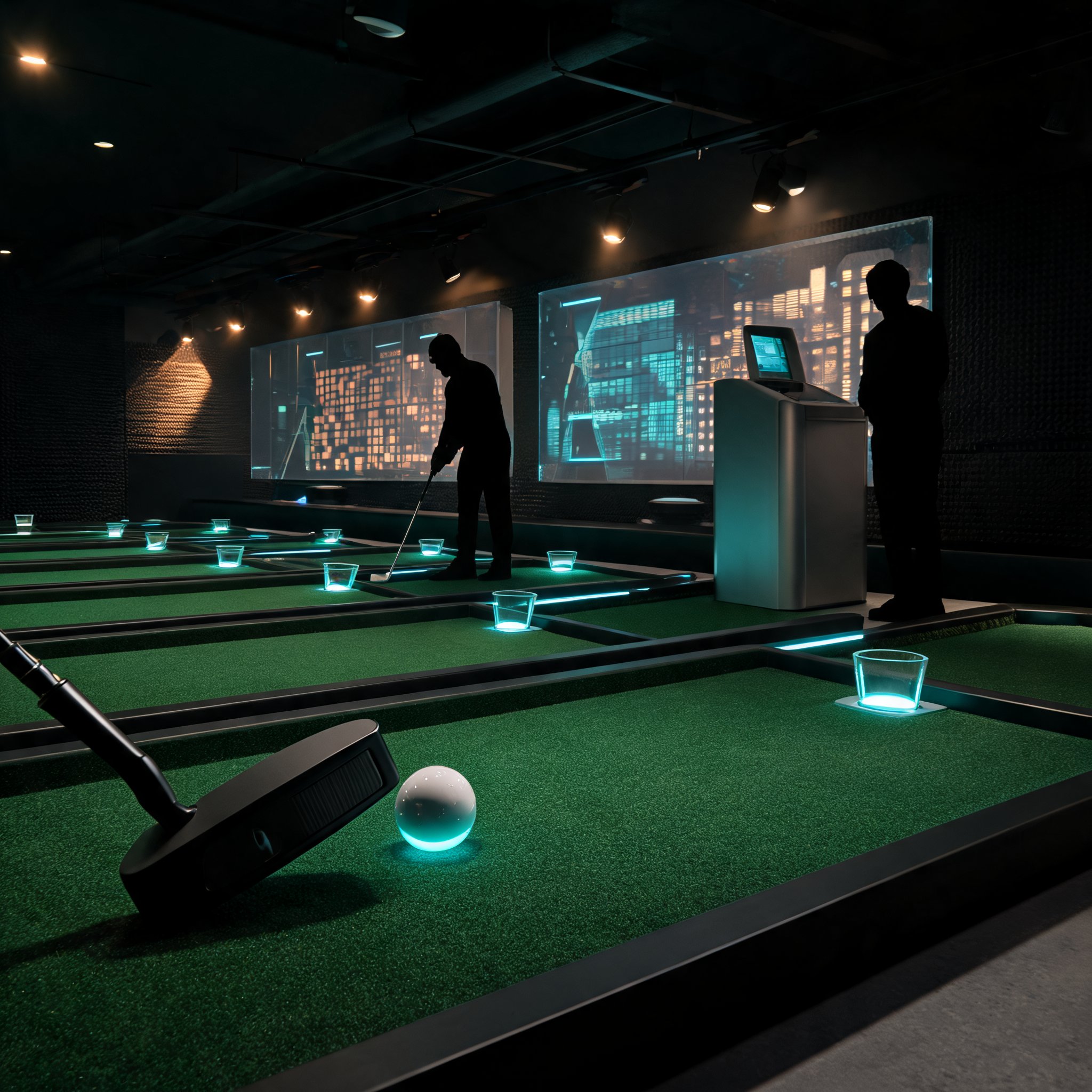
Holovis' 360Golf is not trying to reinvent mini golf. Its pitch rests on a different proposition: keep the format that most visitors already understand, then add automated scoring, gamified challenges and operational analytics so that a familiar social game becomes a repeatable, data-rich attraction for competitive socialising venues.
That distinction matters because mini golf already has broad recognition. 360Golf says demand now spans the UK, Europe, the Middle East, North America and Asia Pacific. Stuart Edgington, Holovis' global director of business development, argues that familiarity is an advantage rather than a limitation. Mini golf is accessible in most markets, so the company can build technology on top of an existing understanding instead of teaching a new sport. The resulting experience is intended to be more competitive and interactive, with measurable commercial value. Visitors can register, collect an assigned smart ball and begin playing with little explanation or staff time, an important operational point for venues.
The appeal is intergenerational: 360Golf says it can draw families, competitive socialising young adults and corporate groups, making it a potential anchor for a wider venue.
From scorecard to game layer
The platform's foundation is automated scoring. Smart balls, tees and cups work with the HoloTrac system to remove paper scorecards and act as a referee when competition is close. On top of that sits a game layer: SuperShots offer alternative ways to score, Triumphs present awards and unlock challenges, and bonuses, on-course games, player accounts, achievements, leaderboards and video celebrations give visitors reasons to compare results and return. Matt Dobbs, business development director, frames this as more reason to compete, celebrate and revisit.
Those features also feed the operator side. The DeepSmarts AI engine supplies analytics on player interaction, seasonality, uptime and venue operations. Holovis says operators can use those insights to shape promotions, target quieter periods or underserved groups, and improve dwell time and food and beverage revenue. The same system can support remote troubleshooting, while the hardware is designed for maintenance and repair rather than quick replacement.
Commercial model depends on flow
The commercial case depends on moving guests through efficiently. 360Golf says its system can handle up to 80 people per hour per course, with kiosk-based onboarding freeing staff to manage guests and secondary spend. Dobbs describes food and beverage revenue as the ultimate commercial driver. At Butlin's Bognor Regis resort, the £15m PLAYXPERIENCE centre opened in 2024 with three nine-hole 360Golf courses: a neon glow course, a Las Vegas-themed challenge and a wheelchair-accessible music-themed course. 360Golf reports that the attraction has drawn 5,000 players in a busy week and grossed around £40,000 per week. Those are company-provided client figures, not independently verified, but they illustrate the throughput model the company is selling.
Flexibility is the mechanism for scaling that model. 360Golf offers tech-only retrofits that can be installed in about six to eight weeks, catalogue holes ready in eight to twelve weeks, and fully custom courses that can take six months or more. Its projects include a 12-hole sports-themed package at Super Social in Leopardstown, Ireland; four Tee Time installations for Norwegian Cruise Line using marine-grade, waterproof and IP-rated technology; and the fully custom Top 9 course at Netflix House, with holes themed around One Piece, Squid Game and Floor is Lava. For multi-site operators such as Saudi Entertainment Ventures, the common technology allows consistency in scoring and operations while theming, layout and branding can vary.
Smaller venues do not need the same scale. 360Golf says a simpler, more cost-effective course can still use the same core scoring and replayability, which suits operators testing the format or building toward a chain. At Lucky Duck in Norway, a custom course adds two routes for each hole, showing how design can extend play without changing the underlying technology.
Design and inclusion are part of the product
Design and inclusion are part of the product rather than an afterthought. 360Golf emphasizes visual spectacle, combining physical scenery with lighting. Its team also adjusts courses for right- and left-handed play, putter sizes, wheelchair access through drop-down top caps, tee placement near the edge and spacing between holes to reduce crowding and safety hazards. That matters because the addressable audience includes families and older guests, not only competitive young adults.
Where the model meets its limits
The limits are equally clear. Custom IP-led projects take months, and returns depend on local demand, throughput and secondary spend rather than technology alone. Edgington also expects competitive socialising eventually to reach peak saturation, which is why Holovis is investigating other markets and sports, including a stroke-counting integration with Roxy Leisure's crazy pool tables. That does not undermine the current mini-golf opportunity, but it shows that the platform must keep evolving.
For operators, the decisive question is whether automated scoring and game layers produce repeat visits rather than a one-off novelty. 360Golf's advantage is integration: a familiar game, a digital scoring and game layer, venue analytics and flexible physical formats. Its constraint is that each venue still needs the right audience, footprint and commercial model, which is why the company frames its offer as turnkey rather than a course sale. Success will be judged on sustained repeat play and operational returns, not on the novelty of the technology alone.